
North American Crop Progress
- Tuesday September 1, 2009
This analysis featured in the September 1, 2009 issue of the HGCA's MI Prospects, Volume 12, Issue 5
The US winter wheat harvest is slightly better-than-average and spring sown crop prospects are generally excellent. Crop prospects in Canada, however, are mixed and generally below average. In both countries delayed maturity is again a concern.
US Winter Wheat
The US winter wheat crop harvest was almost complete as of August 23. Although harvesting progress has in aggregate been slightly behind average, this was probably the result of delayed maturity rather than harvesting conditions and the crop quality is generally good.
The USDA's August estimate placed the crop at 41.8Mt, 18% below the large 2008 harvest (Table 1). The crop was slightly below the five-year average. The condition of the crop was well above average last autumn in advance of dormancy; it was below average condition early in the season but held its rating through to harvest. This reflected the relative favourable crop conditions in later harvested regions compared to parts of Texas and Oklahoma which suffered from drought.
continue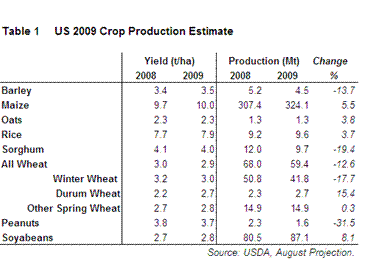
By class the production for Hard Red Winter, Soft Red Winter and White Winter wheat, respectively is estimated at 23.7M, 10.1M, and 7.3Mt, (5 and 10% below the five-year average and 7% above). In particular production of Soft Red Winter declined this year partly due to the late spring crop harvesting last autumn and partly due to better market prospects for maize and soyabeans.
US Spring Wheat
Sowing of the US spring wheat crop was delayed by excessively wet field conditions. In addition, a wet and cool spring meant that, although late, the spring wheat crop has not been subject to any significant stress. Crop conditions have been consistently assessed as favourable (Graph 1). No major issues appear to have arisen as a result of the late harvest, which was reported at August 23 as 22% complete compared to a 66% five-year average and more than two weeks behind the normal pace.
continue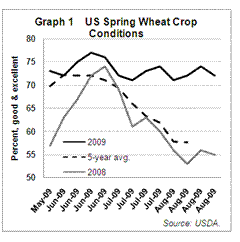
The USDA estimates the spring wheat crop at 14.9Mt with a yield of 2.8tha, 9 and 7% above a five-year average and the largest crop and yield since 2004. The durum wheat crop is placed at 2.7Mt with a yield of 2.7t/ha, 16 and 22% above a five-year average and the largest crop and yield since 2005.
Prospects for Hard Red Spring wheat look relatively favourable, as a much smaller and possibly lower quality Canadian crop is expected (see below). For durum, the situation is not as positive. While the US has been a small net-importer of durum in recent years, the increase in US supplies coincides with much improved North African crops, the major international market for durum.
US Maize
Weather in the Corn Belt has generally been favourable for spring crop development (Graph 2). Moisture has been adequate and there have not been any prolonged heat waves. Conditions were particularly favourable during July and the critical reproductive period. However, crop development has been delayed and the crop is now about 10 days behind the five-year average. This is starting to emerge as a concern. While it was the eastern Corn Belt which experienced sowing delays, the slow development of the crop is now more widespread.
continue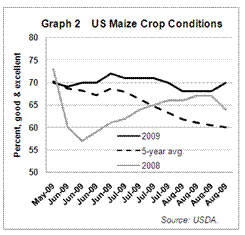
The USDA's first surveyed production estimate placed the yield at 10.0t/ha, slightly below the 2007 record and 5% above a five-year average. But with conditions close to ideal since the survey was taken, record yields seem likely, an early frost aside. Production was estimated at 324.1Mt, 5% above 2008 and 9% above the five-year average.
US Soyabeans
Crop ratings have been consistently above average and the most recent rating was the highest for this time of the year since 1992 (Graph 3). A good crop could, however, be compromised by an early frost. The critical podding period was about a week later than average.
continue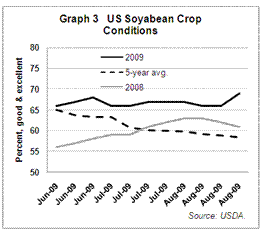
The USDA's August estimate of soyabean yield was 2.8t/ha, 5% above 2008 and about equal to the five-year average. Total soyabean production is estimated at 87.1Mt, 8% above last year and 7% above the five-year average. The condition of the crop has improved since early August and an upward revision of this estimate is therefore anticipated.
Canadian Prospects
Early and mid-season conditions on the Prairies have been very variable with flooding and excess moisture in eastern Manitoba to a relatively large and severe area of drought in east-central Alberta and west-central Saskatchewan. Temperatures have been well below average over almost the entire area. Crop development has been assessed from one week to three weeks behind normal depending on location. Because of this, Statistics Canada's July 31 production estimate provides a less definitive than usual indication of output. Yields for all crops were estimated below year ago levels (Table 2) with in particular canola and spring wheat yields projected 21 and 18% lower.
continue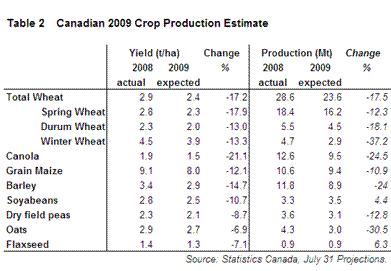
In August, however, almost all drought areas received significant rainfall. This may be of limited value for enhancing cereal yields but could be of value to canola and peas. The moisture will certainly be of value for 2010.
Autumn conditions will be critical for the crop. Luckily weather forecasts are for widespread settled weather. Warm daytime temperatures will hasten maturity but cool night time temperatures may bring frost risk.
A further unknown is how much farmers will choose to take late and poor cereal crops for green feed and swath prematurely to preserve quality at the expense of yield. Revisions in Statistics Canada's September and November crop estimates may occur.
In export market terms, the smaller Hard Red Spring and durum wheat harvest prospects will be offset by improved US output of these crops. Imports of maize and DDGs to supplement domestic barley supplies have already started. A late harvest is not altogether negative for malting barley prospects as cooler temperatures reduce the risk of premature germination. With reduced Canadian oat supplies, the US will be more dependent than usual on Scandinavian sources for oats.
Although canola supplies will be much reduced from last year, the 2009 crop will still be the second largest on record. Australia will undoubtedly be the substitute source in quality conscious Asian markets. An increase in beginning stocks will offset reduced production, but with less than immaculate monsoon in India, quality peas are likely to be in demand.
David Walker (001) 780 434 7615
top of page